Outdoor Christmas Lights: How Many Strands & How to Hang
Part of our guide: Holiday Party Decorations: The Complete Guide
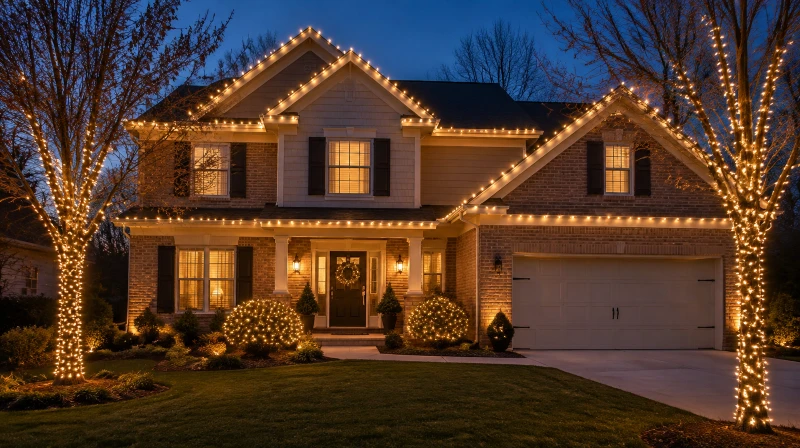
The result: a warm white roofline, two wrapped trees, and two glowing bushes, all on a timer. Time: about 3 to 4 hours with a helper. Cost: about $120 for a 40-foot roofline, 2 trees, 2 bushes, and a spare strand. Skill: easy, but you need a ladder and an outdoor outlet.
Most outdoor light plans go wrong in the same two places: the strand count is a guess, and the lights are hung with nails or staples. This guide gives you a way to count the strands before you buy, shows how to hang them without damage, and covers the safety steps that matter. For the door and the porch, see our Christmas front porch ideas.
Top Decor Picks for this Setup
Curated essentials on Amazon to help you recreate this setup easily.
Warm White LED Mini String Lights 100 Count Outdoor
The roofline and tree strands.
Gutter and Shingle Light Clips 50 Pack
Clips for the roofline, no nails.
Warm White LED Net Lights 4x6 ft Outdoor
Net lights for bushes.
Outdoor Timer with Photocell
Turns the lights on at dusk.
What you need
- LED mini string lights, warm white, outdoor rated: 33 feet per strand (100 lights, 4 inch spacing). Look for the words “outdoor” or “wet location” and a safety listing mark such as UL or ETL on the box. Buy this many, using the counting steps below.
- Gutter or shingle clips: 1 per foot of roofline (40 clips for a 40-foot roofline), plus 10 spare.
- Net lights, 4 by 6 feet, for bushes (1 per bush), or 1 extra strand per bush.
- Outdoor timer (with a photocell or a clock), 1.
- Outdoor extension cord, 16 gauge or thicker, 25 feet.
- A waterproof cover for the plug connections, or a weatherproof box (about $6).
- A ladder, a helper, and a tape measure.
Step 1: Count your strands
Do this before you buy anything.
- Roofline: measure the length you want to light. Divide by 33. A 40-foot roofline needs 2 strands (40 ÷ 33 = 1.2, so round up).
- Tree trunks: a tree trunk wrap needs about 1 strand per tree for a trunk up to 6 feet tall. To check: wraps = trunk height ÷ spacing between wraps, and each wrap uses the trunk’s circumference (diameter × 3.14). A 6-foot trunk, 4 inches wide, with wraps 4 inches apart: 72 ÷ 4 = 18 wraps, times 12.6 inches = about 19 feet. One 33-foot strand covers it with some left over.
- Bushes: use 1 net light (4 by 6 feet) for each bush up to 4 feet tall and 3 feet wide. For a bigger bush use 2 nets.
- Add one spare strand, so a dead strand does not stop the job.
For the example house, that is 2 roofline strands, 2 tree strands, and 2 net lights, plus 1 spare strand.
Step 2: Check the power
- Plug into a GFCI outdoor outlet. If you do not have one, use a plug-in GFCI adapter.
- Read the box for how many strands you can connect end to end. LED strands often allow more than older bulbs, but never go over the number on the label.
- Keep the total load well below the circuit’s limit. Most outlets are on a 15-amp circuit, and LED strands use only a few watts each, but check the wattage on the label if you have many.
- Use an outdoor extension cord with a cover over every plug connection, and keep the connections up off the ground, out of puddles and snow.
Step 3: Test every strand
Plug each strand in on the ground, and look for dark sections before you hang it. Fix or swap it now, since it is much harder to do on a ladder.
Step 4: Hang the roofline
- Set the ladder on firm, level ground, at about a 4 to 1 angle (1 foot out for every 4 feet of height). Have a helper hold it.
- Clip the lights to the gutter or the edge of the roof every 12 inches. Do not use nails or staples, which can pierce the cord and the wires.
- Work from the plug end. Keep the strand loose and straight, not stretched, since cold makes the cord shrink.
- Use only one strand per section, and connect the next strand at a corner or at a pole, so the plug is easy to reach.
- Never lean the ladder on the lights, and stay at least 10 feet away from power lines.
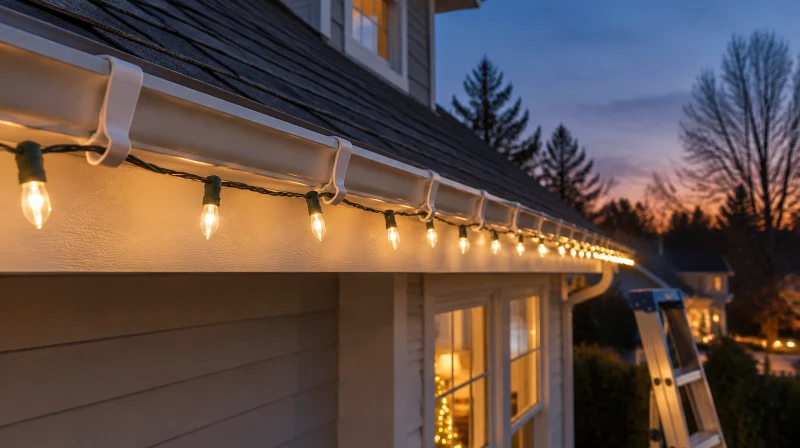 Clip the lights to the gutter every foot. Do not use nails or staples.
Step 5: Wrap the trees and cover the bushes
- Trees: start at the bottom of the trunk, and wrap upward with the lights 4 inches apart. Wrap up the first big branches if you have extra lights. Keep the plug end low, near the ground.
- Bushes: drape the net over the top and pull it down the sides. The net should sit flat, with no folds. Use a small stake or a clip to hold the bottom edge.
- Keep the lights clear of dry leaves, mulch piles, and anything flammable.
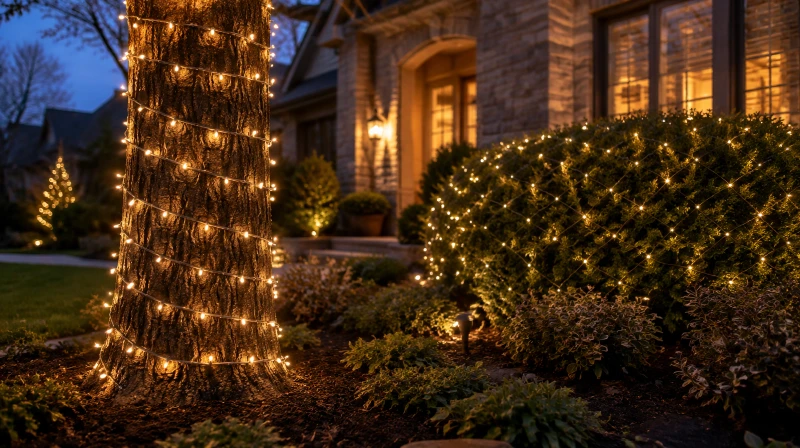 Wrap the trunk with the lights about 4 inches apart, and drape the net flat over the bush.
Step 6: Set the timer
Plug every strand into the timer (never run a strand above the load the timer is rated for, which is printed on it), and set it to come on at dusk and go off at about 11 p.m. That is about 6 hours a night. For a full set of 10 LED strands this is usually a small cost on the power bill, about $1 to $2 a month at average U.S. rates (a planning estimate; your rate may be different).
Before and after
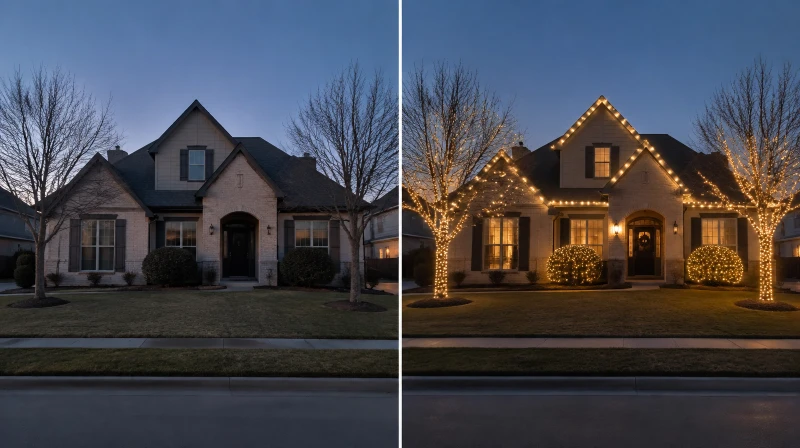 The same house before and after: a roofline, two trees, and two bushes.
Troubleshooting
- Half a strand is dark: check the plug connection, the bulb or the fuse (on older bulb strands), and the gap between bulbs. Swap in the spare strand if you cannot fix it.
- The GFCI trips: there is water somewhere. Unplug, dry the connections, and add a cover. Do not keep resetting it.
- The lights get dim at the far end: too many strands connected end to end. Use another outlet for part of the run.
- The strand sags between the clips: use more clips, about 1 per foot.
- Colors look different: do not mix warm white and cool white strands on one run. Buy them from the same pack.
Mistakes to avoid
- Hanging lights before testing them
- Using indoor lights, indoor cords, or old cords with cracked wires
- Nails, staples, or tape instead of clips
- Hanging lights in rain, ice, or strong wind
- Leaving the lights on all night, which wastes power
- Throwing a pile of lights in a box at the end: wind each strand around a piece of cardboard or a spool
Take down and store
Take the lights down in January on a dry day. Wind each strand around a cardboard piece, tag it (“roofline 1”), and store it in a tote. Test it again next November before you hang it.
Cost list
For a 40-foot roofline, 2 trees, and 2 bushes: roofline lights, 2 strands $20, clips $8, tree lights, 2 strands $20, net lights, 2 nets $30, timer $12, outdoor cord $14, plug cover $6, and 1 spare strand $10. That is about $120. Using 1 strand per bush instead of nets brings it to about $110. These are planning estimates for U.S. stores, exclude tax, and vary by store and region. A ladder is not included.
FAQ
How many strands of lights do I need for my roofline?
Measure the length of your roofline and divide it by the length of one strand. A 33-foot LED strand (100 lights, 4 inch spacing) covers a 40-foot roofline with 2 strands. Always round up and buy 1 spare strand.
How many lights do I need to wrap a tree trunk?
Use the trunk’s height divided by the spacing between wraps, times the trunk’s circumference. A 6-foot trunk, 4 inches wide, with wraps 4 inches apart needs about 19 feet, so one 33-foot strand is enough with some left over.
How do I hang Christmas lights without damaging the house?
Use gutter or shingle clips, about 1 per foot, instead of nails or staples. Keep the strand loose and straight, work from the plug end, and test each strand on the ground before you hang it.
How many Christmas light strands can I plug together?
Read the label on the box, since each product has its own limit. LED strands often allow more strands end to end than older bulbs, but never go over the number on the label. Use another outlet if the far end gets dim.
Is it safe to leave outdoor Christmas lights on overnight?
It is safer to use a timer that turns them off at about 11 p.m. Use outdoor-rated lights and cords, a GFCI outlet, and covers over the plug connections, and keep the connections off wet ground.
What if my roofline needs more strands than one outlet can power?
Split the lights into separate runs, each with its own outlet or timer, and keep each run within the number of strands the label allows. Do not daisy-chain extra strands past the limit, because the far end gets dim and the cord can overheat.
How much does it cost to run Christmas lights?
A set of 10 LED strands used 6 hours a night costs about $1 to $2 a month at average U.S. rates. That is a planning estimate, and your rate may differ.
How much does it cost to put up outdoor Christmas lights?
A 40-foot roofline, 2 wrapped trees, and 2 bushes cost about $120 for LED strands, clips, net lights, a timer, an outdoor cord, a plug cover, and a spare strand, or about $110 if you use strands instead of net lights. A ladder is not included.
Related articles
- Christmas Front Porch Ideas
- Fairy Light Decoration Ideas
- Christmas Party Decorations
- Christmas Tree Decorating Ideas
📌 Pin this for later!
Recreate This Look: Complete Supply Checklist
Every prop, decor item, and material identified in our styled photos, linked directly to top-rated supplies on Amazon.
Powers the lights.
Keeps plug connections dry.
If the outlet has no GFCI.
A spare strand.
Hold the net lights.
Store lights after the holidays.
Wind each strand for storage.
For the roofline.
Keeps the ladder off the gutter.
Find dead bulbs.
Spare fuses for older strands.
Hold lights on fences and railings.
Longer strand for big trunks.
Several plugs at one spot.
Protects the timer.
Grip on the ladder.
Measure the roofline.